Terry Allen, Joe Ely, Wayne Hancock & Butch Hancock
"Chippy: Diary Of A West Texas Hooker" Stage Production (Music Only)
John Jay Theater
New York City, NY
July 29, 1994
(Two Of Us Master Series Volume 337)
Recording: Shure mic > Sony WM-D6C
Transfer: Cassette Master > Nakamichi DR-01 (azimuth adjusted) > USBPre2 Sound Devices > Audacity > iZotope RX 10 / ozone 9 (mastered) > xACT 2.59 > FLAC
01 Give Me My Flowers (While I'm Living)
02 Thunderstorm & Neon Signs
03 Tramp On The Street
04 Fate With A Capital F
05 Flatland Farmer
06 Wind's Gonna Blow You Away
07 Gonna California
08 Downtown Cocksuckers' Ball
09 Buildin' More Fires
10 Goodnight Dear Diary
11 Cup Of Tea
12 Cold Black Hammer
13 Boomtown Boogie
14 Buildin' More Fires (reprise)
15 Whiskey And Women And Money To Burn
16 Back To Black
17 Low Lights Of Town
18 Everybody Gets Their Turn
19 Morning Goodness
20 Roll Around
21 Goodnight
22 Flatland Farmer (reprise)
Known Faults:
-Music Only: recorder paused during dialogue segments creating some beginnings/endings
cut.
-The occasional mic movement/bump (most have been removed)
Terry Allen � piano, vocals
Jo Harvey Allen � spoken word, vocals
Joe Ely � guitar, vocals
Butch Hancock � guitar, vocals
Wayne Hancock: guitar, vocals
Robert Earl Keen: guitar, vocals (likely)
Jo Carol Pierce: vocals
Ponty Bone � accordion
Lloyd Maines � steel guitar, dobro, multi-instrumentalist
Davis McLarty � drums, percussion
Richard Bowden � fiddle, mandolin
Between 1983 and 2002, few tapers were as active as the "Two Of Us." Not only did they capture live performances in their local area, but they also traveled the world to record their favorite artists. Over nearly two decades, they taped over 250 artists, many of whom were recorded multiple times.
Springsteen collectors will already be familiar with some of their work�thanks to "fmcleanboots," who shared a half dozen or so shows from the "Tunnel Of Love" tour before passing the baton. Yet, what may be lesser-known is the depth of their passion�not just for Springsteen, but for music itself. Their dedication resulted in an astonishing catalog of artists and performances.
The "Two Of Us" followed tours relentlessly, recording club shows, theater performances, arena concerts, and everything in between�capturing the sounds of big-name acts, mid-level artists, and local talents alike. On nights when a tour had a break, they sought out other artists performing nearby, ensuring no opportunity to tape went to waste. While their priority was always to enjoy the show, they often acquired tickets outside venues, working tirelessly to secure the best possible seats�sometimes trading up until they achieved the perfect vantage point.
Their recordings are uniformly excellent, though occasionally the start of a show was sacrificed in exchange for securing prime seating. Before adopting DAT technology in later years, they relied on the Sony WM-D6C paired with an external Shure microphone for much of their work. Remarkably, their master tapes�kept in pristine condition within a climate-controlled environment�remain uncirculated, preserving their captures in perfect condition.
This series promises to be an exhilarating journey. While releases won�t always follow chronological order due to the sheer volume of material, mini-series featuring consecutive dates within a tour may be shared. Along the way, we aim to upgrade existing circulating audio and introduce recordings of performances that lack any circulating source. Enjoy the ride�this is not a dark ride.
*******************************************
"Chippy: Diary Of A West Texas Hooker" Stage Production (Music Only) @ John Jay Theater -
New York City, NY July 29, 1994
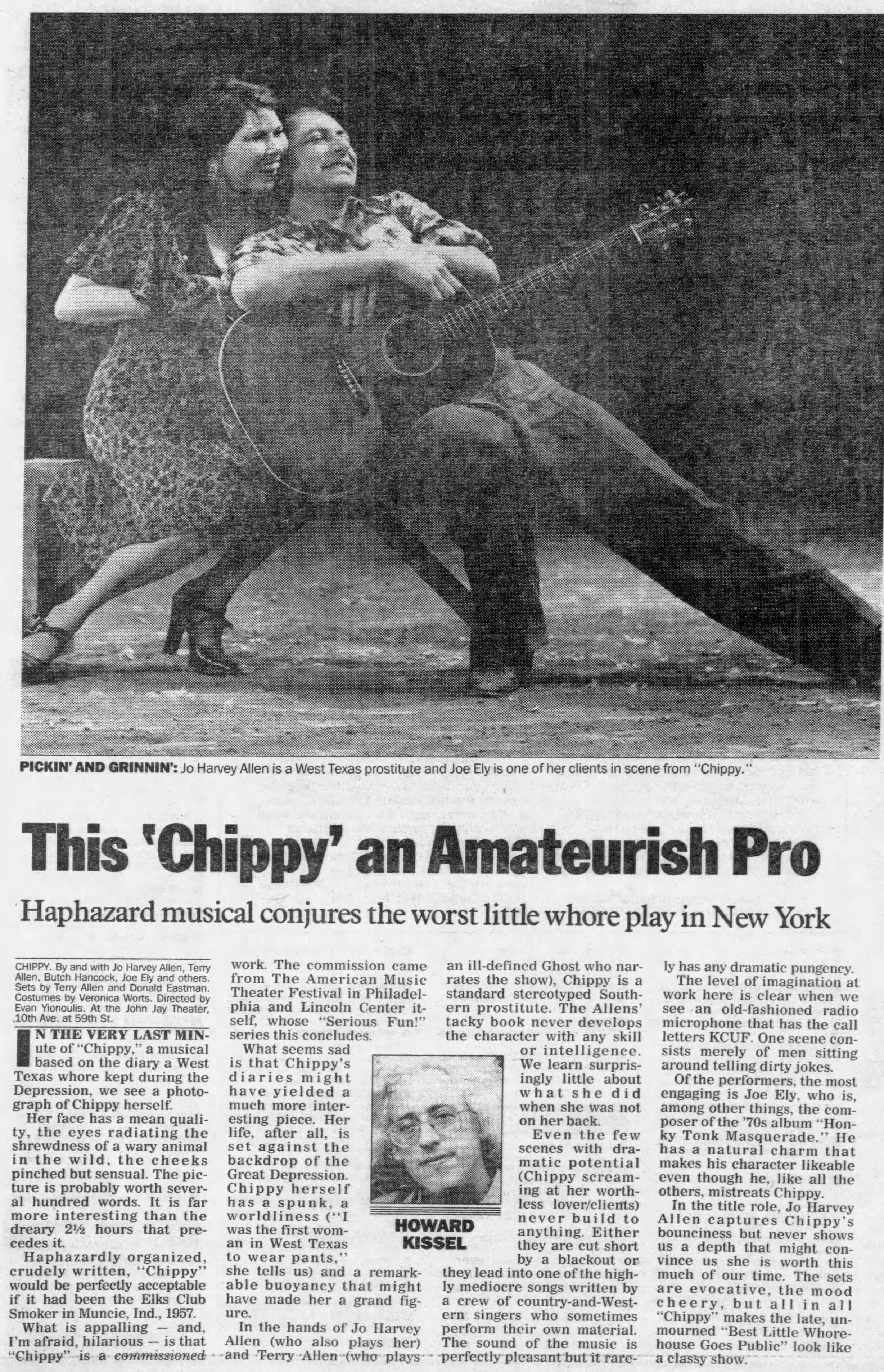
Chippy is one of those curiosities, a 1990s �lost� theatre pieces that sits at the crossroads of alternative theatre, alt-country music, and multimedia performance. It never became mainstream, but among people who know it, it�s remembered as a bold, weird, and very, not entirely successful, 1994 experiment.
It told the story of �Chippy,� a West Texas sex worker, using a mix of monologues, songs, and character vignettes. The tone was gritty, surreal, darkly funny, and deeply Southwestern.
It was inspired by the detailed diaries of a woman known as "Chippy," who recorded her life, meals, and thousands of customers from the Great Depression until her death in the 1960s.
The Chippy CD and the Chippy live stage production share the same DNA, but they feel like two different experiences. One is a gritty, immersive piece of theatre; the other is a curated, musician-driven concept album. Comparing them is a bit like comparing a play to its cast album � except Chippy was never a traditional musical to begin with.
The New York City live stage production features Terry Allen, Joe Ely, Wayne Hancock, Butch Hancock and Robert Earl Keen. It was a multimedia, chaotic, immersive performance. It was Loud, messy, and theatrical, a blend of spoken monologues, projected visuals, film clips, and live music. The stage production was more narrative-driven than the CD, Terry Allen aways intended for the stage production to be a gritty, immersive piece of theatre; the other is a curated, musician-driven concept album.
Chippy's New York City run ran for 4 nights from July 27 to July 30, preceded by 5 days of rehearsals. This was the last series of performances, previous performances took place over 3 nights in Philadelphia June 3, 4 and 5 preceded by 5 days of rehearsals and as a work in progress in January & February 1993 in Ft. Worth, Lubbock and Santa Fe. The album was recorded in Austin in January-February 1994.
The stage versions were not full songs � many were partial, rearranged, or underscored monologues.
The Two Of Us recording cuts out the dialogue and preserves only the music, this is probably for the best as one of the knocks on the production was the narrator and actors were difficult to hear. I've included a couple of newspaper and online reviews which are less than positive about the production.
Though the stage production could not be called successful it did contain some outstanding music, as does the CD, with performances of the majority of the songs only ever played live during this production.
Our deepest gratitude goes to the "Two Of Us" for their dedication to capturing these legendary performers and preserving shows that many are hearing for the first time. The countless hours spent waiting in line, traveling, purchasing tickets, and trusting me to safeguard their life's work do not go unnoticed. Our community owes you both an immense debt of thanks.
A big thank you to my friend "fmcleanboots" for making the connection to Two Of Us and laying the foundation for what has become an extraordinary series of releases.
Goody masterfully dialed in the pitch, just as he does night after night on all our releases.
The sheer number of uncirculated shows "Two Of Us" taped and continue to provide for release is truly staggering.
Artwork is included.
mjk5510 & Two Of Us
---
There is indeed work to be done on "Chippy: Diaries of a West Texas
Hooker," Terry and Jo Harvey Allen's musical, presented as a work in
progress in Philadelphia early in June.
As an extended jam, as a performance of music, it's a most enjoyable
performance. The Allens team with Joe Ely, Butch Hancock, Jimmie Dale
Gilmore, Jo Carol Pierce, and actor Barry Tubb for some two dozen songs,
of which six are Depression-era covers. As a narrative, though, "Chippy"
has many weak moments, and a sometimes weak presentation makes the play
all the more difficult to follow.
I'm glad I saw "Chippy" for two of the three nights it ran (missing
the final performance). An early draft of this review, written after
seeing the debut, criticized the play for leaving too much out of the
story. After the second night's performance, I realized the problem
wasn't with the script but rather with the performers. Used to stepping
up to a mike when singing, they weren't compensating for the Plays and
Players Theater's adherence to the dramatic tradition of unamplified
dialogue. They were more often than not at a normal conversational level,
in fact, and sometimes mumbled. Fortunately, the second night, they spoke
clearly during many of the parts I hadn't heard the first night (though
mumbling others), letting me fill in what I'd thought were the gaps in
the story. Even in an intimate setting -- the theater's capacity was 230,
including a sizable balcony -- the performers will need to project their
voices more if and when the play is mounted again.
The one exception to this was Pierce, who as Texas historian Barbara
Ledbetter introduced most scenes by reading from Chippy's diary. Pierce
projected well, but spoke much too quickly and in a monotone, always
sounding rushed. It was hard to get a feel for the progress of time, even
though each entry began with the date, because no emphasis was given to
more important information; it all blended together.
"Chippy"'s plot is thin at best; it's more a series of vignettes
adapted from entries in the diaries. The first scene takes place in 1967,
in the 51-year-old Chippy's bedroom, as she chats with Ledbetter. She
gets out of bed and introduces herself to the audience in an extended
monologue with some wonderful lines ("I hitchhiked all over Texas. See
this thumb? It's been stuck in more places than I care to remember").
Returning to her bed, she continues to reminisce with Ledbetter and,
while looking at pictures of herself in action in her working days (one
of which is shown on a large-screen video system), dies. Four of her
former johns -- Terry Allen as Ghost, Ely as Tuck, Hancock as Charles
Travis, and Gilmore in an unnamed role -- come in and take her body away.
Ledbetter steps forward and in a monologue fills in many other details of
Chippy's life and introduces the series of flashbacks to the 1930s that
serve as the scenes of the play.
While the scenes are mostly self-contained vignettes, there's some
continuity. Early on, for instance, Chippy refers to the tracings she
makes of her johns' genitals, which later serve as the focus of a very
funny and moving scene near the end of the play; as she and her friend
Ruth (Sharon Ely) cut out the tracings, Chippy describes in a
matter-of-fact tone of voice how she felt being raped as a young child by
her father.
Similarly, references to Chippy's ex-husband Buddy and her dead
children -- one stillborn, one dead a weak after birth -- crop up here
and there after their introduction in the opening monologues,
particularly in the third scene, in which Chippy meets a young musician
named Buddy (played by Hancock) who's going to California.
But this web of continuity doesn't really serve as a plot, and there's
too little cohesion among the scenes. Too often, events seem forgotten as
soon as they've occurred. Some scenes, however enjoyable they are, don't
really offer any help in understanding who the characters are and what
their relationships are.
Aside from their speaking volume, Terry Allen, Ely, Hancock, and Tubb
carry their roles as Chippy's johns well, though as a fan of the first
three musically, it took me a while to accept them in their stage roles
-- my fault, not theirs. Gilmore spends most of his time as "Mr.
Jukebox," less a character in the play than a Greek chorus, singing
country hits of the era ("I'm So Lonesome I Could Cry," "It Makes No
Difference Now" and so on) and joining in various choruses.
The music is a joy from start to end, with the highlight being a
wonderfully ragged barbershop quartet version of the period song
"Downtown Cocksuckers Ball"; the original "Boomtown Boogie," where the
four swap off lead vocals in an energetic jam session to segue from an
outdoor scene to a barroom, is also a lot of fun -- as the only long
uptempo number, it becomes an extended romp where the musicians
believably project their characters into a late-'30s West Texas
honky-tonk.
Some of the songs, such as Ely's "Gonna Rock My Baby to Sleep," seemed
fragmentary, perhaps themselves works in progress. But despite its weak
title, "Cup of Tea Song," written by him and Jo Harvey Allen, is as sly
and sexy as his "Settle for Love." Pierce sang "I Blame God" both nights,
earning strong applause; the second performance, she added "Across the
Great Divide" between two scenes.
Pierce also turns in the play's strangest performance; immediately
after the intermission, she as Ledbetter dispenses with introducing
scenes by reading from the diaries and instead introduces the scene of
Chippy in church on Easter morning by repeatedly shouting "Glory!" and
"Jesus!", finally collapsing. I still don't know what to make of it.
But even though the performance is a musical, it's also a play, and I
found it frustrating that the story wasn't stronger. I might have thought
it stronger had the dialogue been more audible, but over the course of
the two nights I think I heard the entire show and, even with the gaps
filled in that fashion, I still don't feel like I saw an entire play. I
understand that the vignette format doesn't require a strong plot, but
I'd like it to be stronger than it is; I'd like to feel the characters
made some progress in some direction from the beginning of the play to
the end.
-Bob Soron
Images for all shows as well as full size images for this show.
Images for this show:
.jpg)
.jpg)
.jpg)