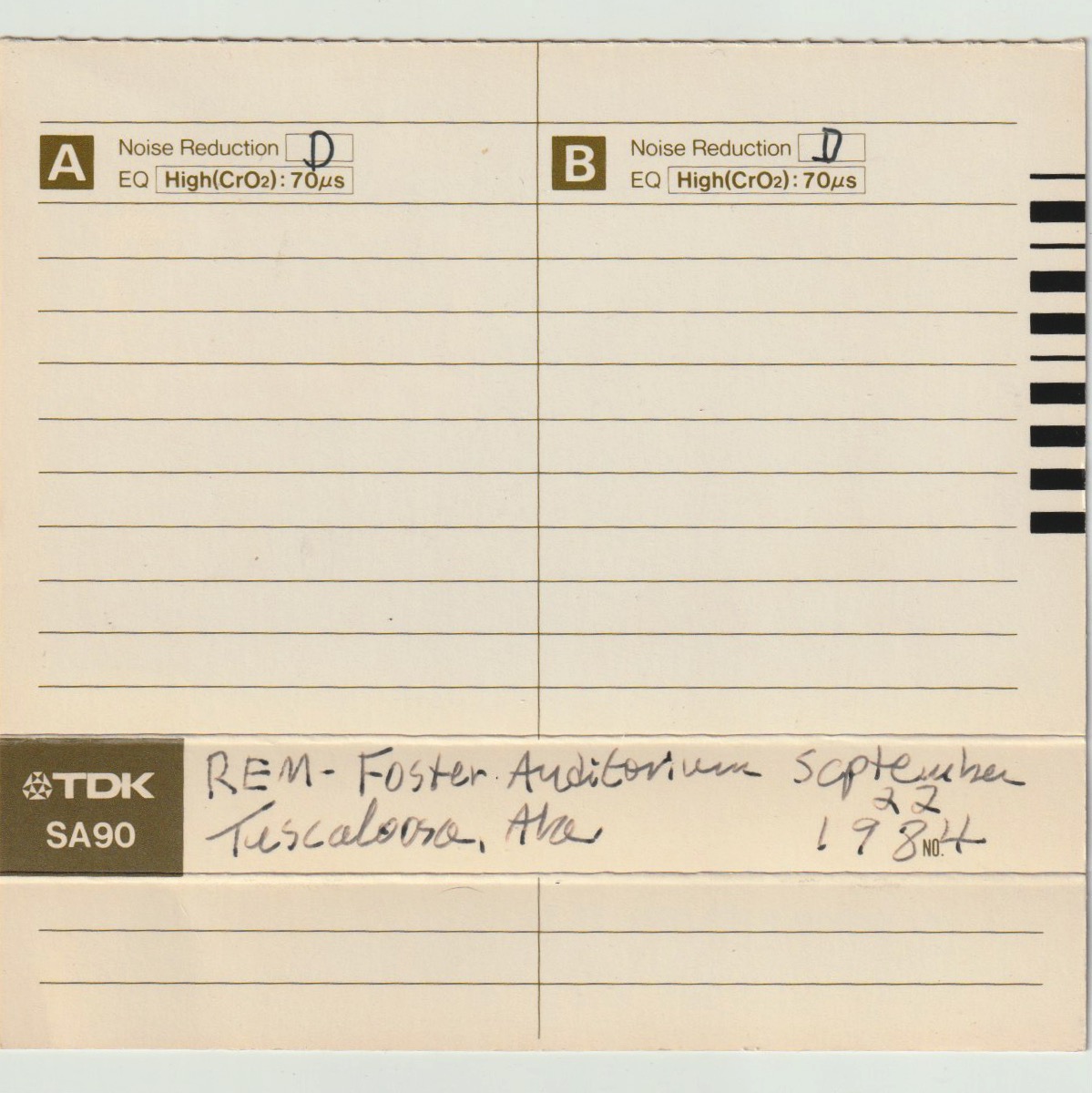
R.E.M.
Foster Auditorium
Tuscaloosa, Ala.
Sept. 22, 1984
01. (applause) :33
02. 9-9 2:52
03. Windout 2:35
04. Talk About the Passion 3:32
05. Kohoutek 3:32
06. So. Central Rain 4:00
07. Seven Chinese Brothers 4:15
08. Driver 8 3:21
09. Letter Never Sent 3:33
10. (Don't Go Back To) Rockville 4:34
11. Pilgrimage 4:19
12. Hyena 3:11
13. Just A Touch 2:26
14. Pretty Persuasion 3:39
15. Old Man Kensey 3:11
16. Radio Free Europe 3:35
17. Little America 3:43
18. Ghostriders in the Sky 2:33
19. Second Guessing 2:59
20. Sitting Still 3:25
21. Femme Fatale 2:58
22. 1,000,000 3:12
23. Moon River 2:17
24. We Walk -> Behind Closed Doors -> After Hours 4:49
25. Sweet Home Alabama 3:58
26. Carnival of Sorts (Boxcars) 4:01
27. Skank (cut) 6:06
Total: 93:21
Source: unknown mics > unknown recorder > Tommy Stevenson's master cassette > Shelly Rosenzweig's first-gen cassette (TDK SA 90)
Transfer: first-gen cassette > Nakamichi CR-1A (head azimuth optimized) > Metric Halo MIO-2882 > Macintosh MacBook Pro > MIO Console 5.6 > wav > MacBook Air M1 > iZotope RX 12 Advanced (Azimuth tool used to center stereo image; normalized 2.0 db, various major repairs - see notes) > xACT 2.59 > flac (24/48)
Notes
This is from the Sheldon Rosenzweig collection. Special thanks to Shelly for sharing his tapes. Transferred by Richard Russell, November 2026.
I am fairly confident this was recorded by Tommy Stevenson and not Shelly. The severe alignment flaws and deteriorated sound issues at the beginning of Side 1 and Side 2 are identical to the issues found on large number of Stevenson's masters. I hear both guys talking on the tape.
Tape flip occurs just before Track 15.
The use of Dolby B is indicated on the cassette, but I did not use it on playback.
Other than the repairs noted below, no eq or noise reduction was applied to this recording.
Recording restoration notes
As mentioned above, this tape suffered from significant sound issues at the beginning of Side 1 (Tracks 1-3) and Side 2 (Tracks 15-16). The garbled sound was due to tape misalignment that occurred each time recording was initiated when a cassette was loaded into the portable cassette recorder. The result was a swirling effect where frequency response deteriorated significantly, repeatedly, every few seconds over several minutes. Thankfully the damage only occurred for about five minutes on each side. (Playback on different machines resulted in identical results, confirming the problem was inherent in the recording, not playback.)
Additionally, there were at least five stretches on side two that suffered from severe dropouts in the left channel.
I used Anthropic's Claude agent (Opus 5.5) to assist in repairing these issues. The results are not perfect, but the recording is (arguably) now listenable. Over several days, I guided "Claude" through the repairs, tweaking the logic used to identify and then repair damage to the extent possible. Afterward I did additional manual cleanup.
Alignment repair
A recorder alignment fault at the start of recordings left moving high-frequency "valleys" on the tape, making the treble extremely dull and wavering. Custom-written software traced the damage in the spectrogram and measured its depth (relative drop in volume by frequency) moment by moment. It then restored the lost frequencies with precisely shaped, time-varying equalization, choosing a different method for each damage pattern. Safeguards kept repairs from exceeding the recording's own undamaged brightness and from touching undamaged passages. Both sides now sound closer to their clean sections; final touch-up EQ was done by hand. The damaged areas were the first 5:40 of Side 1 (ending about 1:34 into Track 3), and the first 3:55 of Side 2 (all of Track 15 and the first 43 seconds of Track 16).
Dropouts
The tape's left channel had frequent dropouts -- brief drops in volume of 5–30 dB lasting about 1 millisecond to 1 second. I used the healthy right channel as a reference guide, as the right and left track each other pretty closely. (In other words, while the recording is made in stereo, the left and right channels typically sound very similar.) An automated process compared the two channels, millisecond by millisecond, to find damage. It uses high frequencies to pinpoint where each dropout starts and ends because the two channels match most closely there and the change is most abrupt. It then restores the left's level frequency band by frequency band to approximate the right, leaving healthy audio untouched. There is still some audible scratchiness and crackle in places.
The repaired excerpts were a 3.9-second passage at 1:20 into Track 19, 4.4 seconds at 2:07 into Track 21, 4.5 seconds at 2:59 also in Track 21 (during applause), about 14 seconds in Track 24, and 18 seconds at 3:13 into Track 25.
Images for all shows as well as full size images for this show.
Images for this show: